A thoughtful seven-day Bhutan itinerary

Seven days of leave gives you five or six days on the ground in Bhutan’s western valleys — Paro, Thimphu and Punakha — with Tiger’s Nest as the walking centrepiece and real time between the stops. It is not enough to add Phobjikha or Bumthang without turning the week into a drive. A credible week is defined as much by what it refuses as by what it includes.
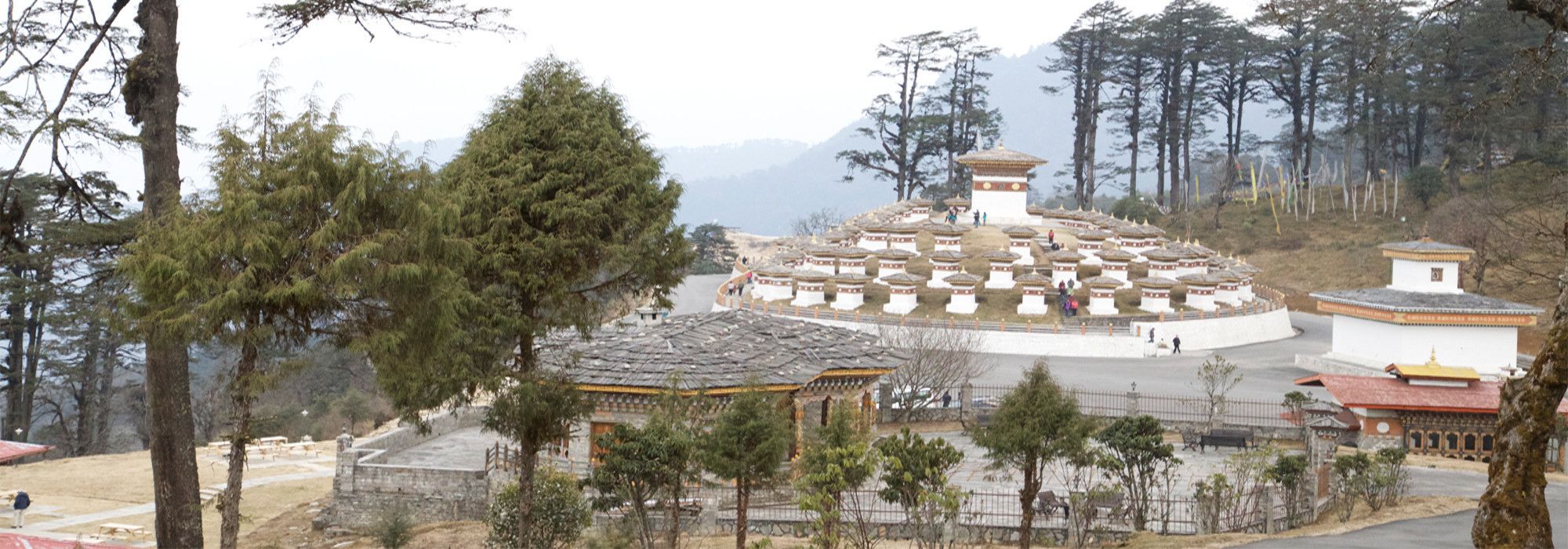
Dochula, at 3,080 m — the crossing between the Thimphu and Punakha valleys, and the high point of the week.
The week in numbers
Leave required — seven days, including both travel days.
On the ground — six days and five nights.
Valleys — Paro, Thimphu, Punakha.
Highest point driven — Dochula pass, 3,080 m.
Highest point walked — Taktsang monastery, 3,120 m.
Longest single drive — 120 km, Punakha to Paro.
Total road distance — about 250 km across the week.
Biggest day on foot — roughly 10 km with 870 m of ascent.
Physical demand — gentle, apart from one demanding walk.
Best months — March to May, and late September to November.
Distances are from our own itinerary data. Drive times are estimates — see the note in the body about why we are not quoting them to the minute.
Who this is for
This is for someone with roughly a week of leave who wants to know whether that is enough, and what a good week actually looks like.
First-time visitors to Bhutan, which is most people — the western valleys are the right first week.
Culture-first travellers who want dzongs, valleys and temples rather than a trek.
Anyone with fixed leave who cannot simply add days, and needs the week to be built properly rather than filled.
Who this is not for
Anyone who wants Bumthang. It is a long way east and adding it to a week means two days in a vehicle to buy one day in the valley. Do it in ten days or do not do it.
Anyone who wants to trek. A supported trek needs its own week, not a corner of this one.
Anyone who needs a rest day mid-week. This week does not have slack for illness or fatigue — it has slack for weather, which is different.
Does seven days actually mean seven days?
No, and this is worth clearing up before anything else because it is where most disappointment starts. Seven days of leave buys you six days on the ground and five nights.
Your first day is a flight into Paro, which for most people means an overnight connection through Delhi, Kathmandu, Bangkok or Singapore, landing mid-morning. It is a real day, but it is a day that begins in an aeroplane. Your last day is breakfast and the drive to the airport. Between them sit four full days, and those four days are the itinerary.
It also matters for what you pay. The Sustainable Development Fee is charged per night, not per day — five nights, not seven. If an operator quotes you seven nights for a seven-day trip, ask which nights they mean.
Four full days is what a week in Bhutan actually is. Every honest decision about the itinerary follows from that number.
The week, day by day
Day one — arrive at Paro, drive to Thimphu
The descent into Paro is genuinely one of the more memorable arrivals in commercial aviation — a banking approach between ridges into a valley at 2,250 m. Then a 55 km drive to Thimphu along the river, pausing at Chuzom where the Paro and Thimphu rivers meet and three stupas in three architectural styles stand together.
We do not programme the afternoon. You have been travelling, you are now at 2,400 m, and the useful thing is a walk through the craft bazaar and an early night. The capital has no traffic lights, which is the fact everyone repeats, and a genuinely ordinary working-city rhythm underneath it, which is the more interesting part.
Day two — Thimphu, on foot
The first proper day, and deliberately a walking one rather than a driving one. Start at Buddha Dordenma above the valley, then descend the Buddha Nature Trail — about two hours through pine, birch and rhododendron, strung with prayer flags — coming out at Changangkha Lhakhang, a twelfth-century temple above the town.
Afternoon is the paper-making workshop, the post office, and Trashichhoedzong, which houses both the government and the central monastic body. Roughly six kilometres on foot across the day, all of it between 2,300 and 2,600 m. This is the acclimatisation day, and it is disguised as a sightseeing day on purpose.
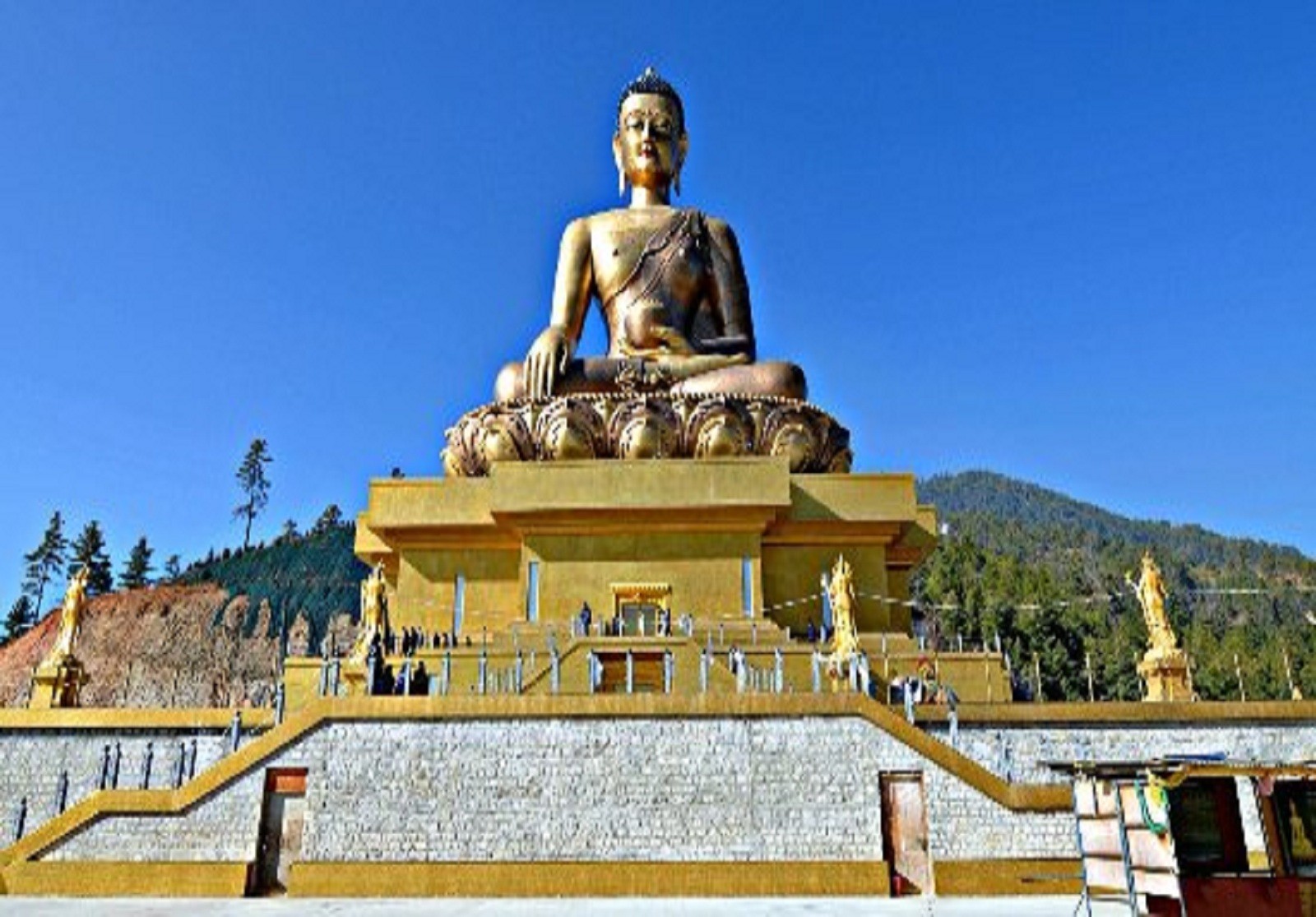
Buddha Dordenma, above Thimphu — the start of the Nature Trail rather than a viewpoint stop.
Day three — over Dochula into Punakha
75 km east, crossing the Dochula pass at 3,080 m. On a clear morning the eastern Himalaya is laid out behind the 108 memorial chortens; on a cloudy one you get the chortens and the prayer flags and not much else, and there is no arranging around that.
Then a long descent — 3,080 m down to 1,300 m — into a subtropical valley where the rice is growing and the temperature is ten degrees warmer. The walk to Chimi Lhakhang through paddy fields and village lanes takes about twenty minutes each way and is the best short walk of the week. Punakha Dzong sits at the junction of the Mo Chhu and Po Chhu, and is the building people remember longest.
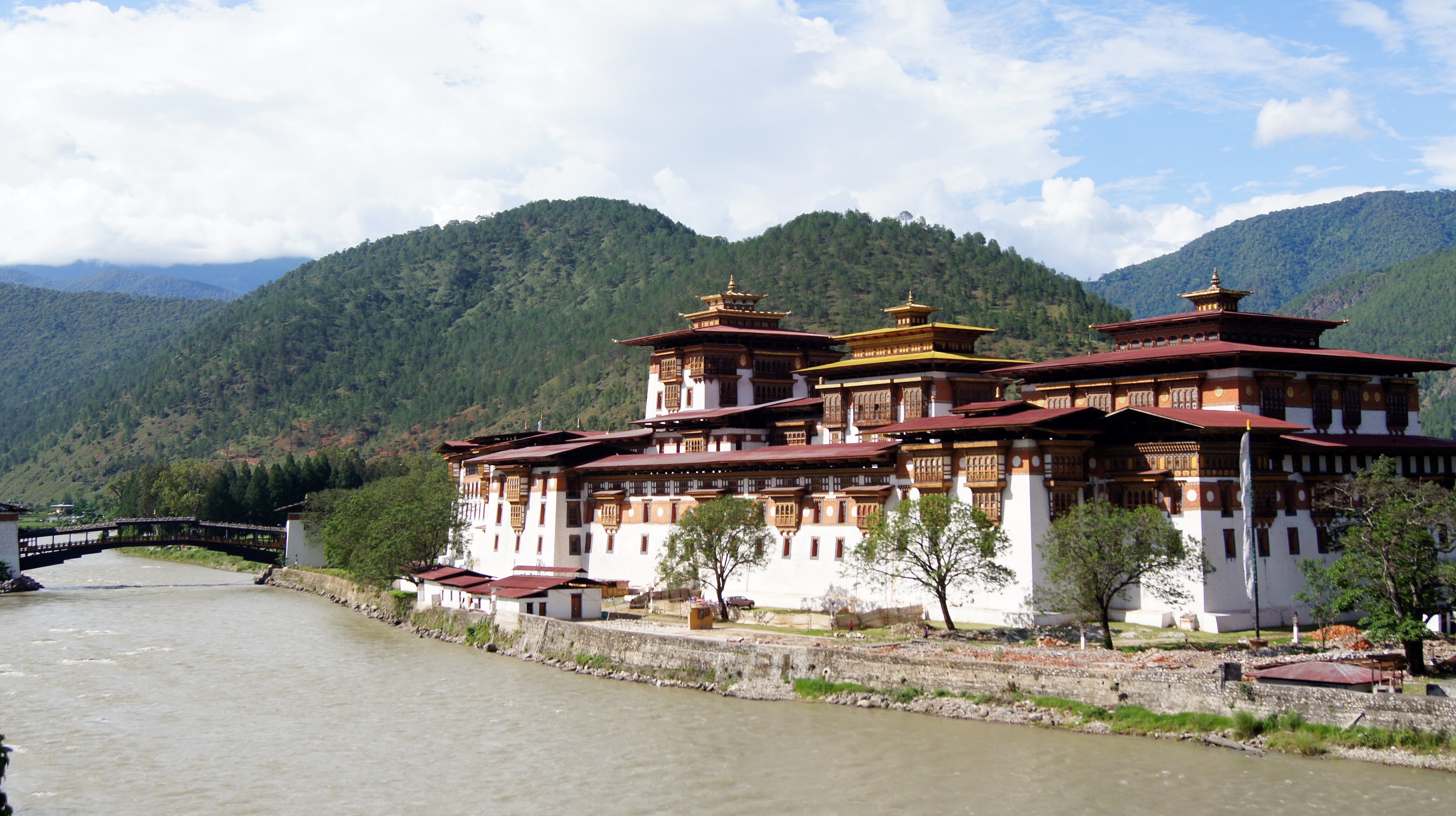
Punakha Dzong, at the river confluence — the warmest and lowest point of the week at 1,300 m.
Day four — the long drive to Paro
The one genuinely long day in the vehicle: 120 km back over Dochula and west to Paro, climbing from 1,300 m to 2,250 m. It is the price of Punakha, and it is worth paying — but it is a driving day and it should be planned as one rather than discovered as one.
We break it: Simtokha Dzong, the oldest fortress in the country, sits on the route rather than off it. In Paro, the National Museum in the old watchtower and then down to Rinpung Dzong, whose galleries carry the wall paintings most people photograph.
Day five — Tiger’s Nest
The day the week is built around. Roughly 10 km out and back, 870 m of ascent from the road head at 2,250 m to the monastery at 3,120 m, about five hours on foot including time at the top. We start at seven.
It sits on day five and not day two for reasons worth stating: by now you have been between 2,300 and 3,100 m for four days and crossed Dochula. The acclimatisation has happened quietly, in the course of ordinary sightseeing. Putting this walk on day two means doing it on unadjusted lungs and aeroplane legs, which is a worse day for no gain.
The afternoon is deliberately light — Drukgyel Dzong and Kyichu Lhakhang, both short, both close. What the day does not contain is a second ambitious thing. The full account of the walk is here, including what the staircases do to your knees and where the horses actually stop.
Day six — departure
Breakfast, and the drive to the airport. That is the whole of it, and it should be.
Why aren’t there exact drive times on this page?
Because we would be guessing at a precision we do not have, and drive times are the number people plan around most.
What we know exactly is distance: 55 km Paro to Thimphu, 75 km Thimphu to Punakha, 120 km Punakha to Paro. What turns those into hours is Bhutan’s road network, where an average of 30 to 40 km/h is normal and road works, weather and livestock all move the figure. As a working estimate: Paro to Thimphu is comfortably under two hours; Thimphu to Punakha is around three including the stop at the pass; Punakha to Paro is the long one, four hours and up with the stops built in.
What did we leave out, and why?
This is the more useful half of any itinerary, and it is almost never published.
Phobjikha and Gangtey
Around three hours beyond Punakha on top of a week that already contains one long drive. Adding it means a day driving there and a day driving back to buy one day in the valley. Do it instead on: ten days, or a winter journey built around the cranes.
Bumthang
Bhutan’s Buddhist heartland, and a very long way east. Two days in a vehicle, minimum, in each direction. Do it instead on: twelve days or more.
Haa and Chele La
The pass is spectacular and the detour is real. It competes directly with the Tiger’s Nest day for the only spare slot. Do it instead on: an eighth or ninth day, where it fits neatly.
Any trek
A supported trek is not a component you slot into a cultural week. Even one night out needs its own arrangement. Do it instead on: its own journey.
Our judgment — the day most weeks overload, and what it costs on day five. Day three. It is the day with the pass, the descent, the fertility temple and the dzong, and it is very tempting to add the suspension bridge walk, a farmhouse lunch and a second temple to it — every one of those is genuinely worth doing, and the day is already full.
What happens when you add them is not visible on day three. It is visible on day five, at the bottom of the Taktsang climb, when someone who has had four fourteen-hour days looks up at 870 metres of ascent and quietly decides they will wait at the cafeteria. We have watched this happen. The overloaded day is never the one that goes wrong.
So we protect day three by keeping it to the pass, Chimi Lhakhang and the dzong, and we keep the afternoon of day four shorter than it could be. The hours we are giving up are real. What they buy is a walker who arrives at day five with something left.
Where is the slack, and what is it for?
There is deliberate spare capacity in this week, and it is not where people expect. It is not a rest day — six days is too short for one. It is distributed:
The unprogrammed first afternoon. If your flight is delayed, which happens, nothing is lost. If it is not, you get an easy evening in Thimphu, which is the right way to start.
A light day four afternoon. If Dochula is fogged or the road is slow, day four absorbs it. If not, you have a genuinely unhurried afternoon in Paro.
Day six behind the big walk. If day five is weathered out, the walk can move to day six for anyone on an afternoon flight. This is the whole reason Tiger’s Nest is not on the last day.
What this week does not have is slack for illness or altitude trouble. That is an honest limitation of six days rather than a design flaw, and it is the main argument for taking eight or ten if you can.
What changes with eight or ten days?
Eight days is the single best upgrade available, and it is not because you see more. It is because you add a night in Punakha instead of driving out the next morning, and the whole week decompresses. Ten days opens Phobjikha properly, which in winter is the strongest reason to go at all.
Twelve or more is where Bumthang becomes honest rather than heroic. We have a fuller account of the day-count question coming — how many days you really need [NOT PUBLISHED YET — leave as plain text, do not link] — but the short version is that the jump from seven to nine changes more than the jump from nine to twelve.
How this changes the journey. The Sacred Valleys route is this week, published. Six days, five nights, Thimphu then Punakha then Paro, with Taktsang on day five and a light day behind it. The visa and the Sustainable Development Fee are handled and included; what you supply is a passport scan and a photograph.
If you have the extra days, the Heart of Druk is the version that reaches Phobjikha and Bumthang without compressing anything, and Bumdra Sky Camp is the version that adds a night at altitude and arrives at Taktsang from above. Those are different journeys rather than this one with days bolted on, which is the point.
Questions we are actually asked
Is one week enough for Bhutan?
For the western valleys, yes — Paro, Thimphu and Punakha with Tiger’s Nest as the centrepiece works properly in the six days on the ground that a week of leave buys. It is not enough for Phobjikha, Bumthang or any trek. A week in Bhutan is a real journey as long as you accept it is a journey through the west.
Can I add Phobjikha to a seven-day trip?
Not without damaging the week. Phobjikha sits around three hours beyond Punakha, so adding it costs a day of driving in each direction to buy one day in the valley — on a week that already contains a 120 km transfer. If Phobjikha matters to you, plan ten days.
How much time is spent driving?
About 250 km in total across the week, in three legs: 55 km Paro to Thimphu, 75 km over Dochula to Punakha, and 120 km back to Paro. Only the last is a long day. Bhutan’s roads average 30 to 40 km/h, so distance translates to hours less generously than it would elsewhere.
Is Tiger’s Nest included, and how hard is the walk?
It is the centrepiece of day five. Roughly 10 km out and back with 870 metres of ascent, about five hours on foot. Sustained rather than technical — if you can walk uphill for two hours without needing to recover, you can do it. The staircases near the end are harder on knees than the climb is on lungs.
What is the best month for a seven-day itinerary?
March to May or late September to November. This route works in almost any month, which is why we suggest it when dates are fixed and cannot move — but spring brings colour and haze, and autumn brings clear mountains and crowds.
Why is Tiger’s Nest on day five rather than earlier?
Acclimatisation and weather margin. By day five you have spent four days between 2,300 and 3,100 metres and crossed a 3,080 m pass, so the altitude has been handled quietly through ordinary sightseeing. And there is a day behind it — if day five is weathered out, the walk can move.
Sources
Neri itinerary data — distances, elevations, ascent figures and the day structure are our own operating data, and match what the Sacred Valleys journey page publishes. Drive times are estimates derived from those distances, and are labelled as such.
Bhutan Tourism FAQs — the guide requirement and the per-night basis of the Sustainable Development Fee.
Compare the journeys. Compare this week against the longer journeys, or tell us how you like to travel and we will say honestly which one fits.
Related Field Notes and next step
Punakha beyond the dzong (To be published)